
Barrier Performance,
Engineered In
The established OLUNRO portfolio for food-grade and demanding applications — barrier coatings, vacuum metallizing and BOPA nylon. Four lines, each with its own published technical guide. Where a two-ply metallized PE structure can replace a three-ply laminate, the reasoning is set out in PE metallized film: two layers instead of three.
Metallized PE — Recyclable Barrier
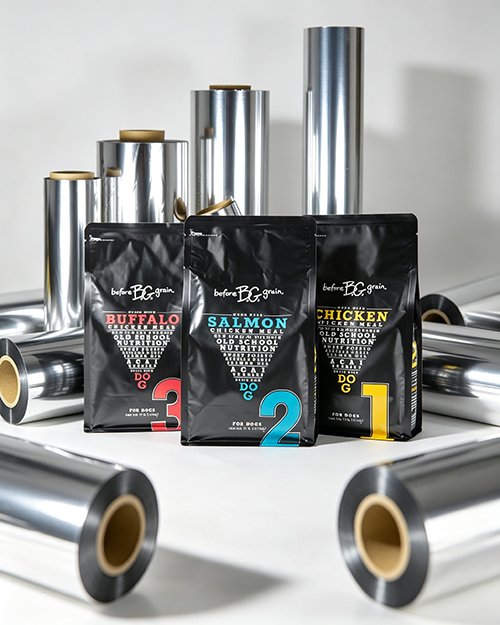
Metalized PE film
Aluminum-metallized PE delivering light, oxygen and moisture barriers while staying mono-material — a recyclable alternative to metallized PET in many structures.
Enquire NowHigh barrier metalized PE film
Enhanced metal adhesion and barrier tuning for applications that need the recyclability of PE with metallized performance — engineered for consistent high-speed converting.
Enquire Now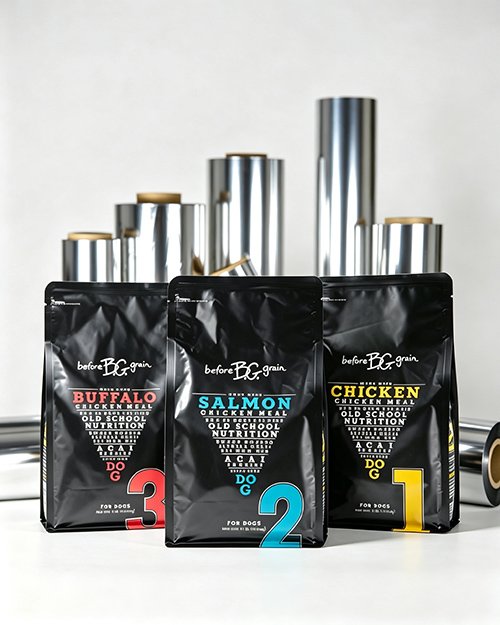
Four Established Lines
Each line has its own technical guide — structures, barrier data and converting notes. Follow the link for the detail.
PVDC & acrylic coated films
Eleven standard coating configurations across BOPA, BOPET and BOPP — single or double sided, with matte and heat-sealable options.
PVDC and acrylic coated filmsMetallized films
Vacuum-aluminized CPE (cast PE) is our main metallizing substrate, with CPP, PET and BOPA also available — moisture barrier improved by one to two orders of magnitude over the base substrate.
metallized BOPET, BOPP and CPP filmsBOPA nylon film
Cast and then stretched in both directions — outstanding puncture resistance, service range −20 °C to 120 °C.
BOPA nylon filmAluminium & PE composite
PET/AL/PE laminates from 26 µm to 200 µm total, with a 6, 9 or 12 µm aluminium layer — dry-laminated for a pinhole-free barrier.
aluminium foil / PE composite filmBuilt for Demanding Packs
Barrier where it matters
Oxygen, moisture, light and aroma barriers selected per structure — not a single grade stretched across every application.
Food-grade documentation
FDA and EU 10/2011 documentation is provided with food-grade shipments, alongside a technical data sheet per product.
Published technical guides
Structures, barrier data and converting notes are available per line, so your team can evaluate before sampling.
A recyclable option
Where the pack allows it, metallized PE keeps the structure in one polymer family instead of adding another layer.
Which Barrier the Pack Actually Needs
Barrier is a cost, not a virtue. The job is to buy the least of it that still holds the shelf life — and the answer moves with the contents, the format and the abuse the pack sees in transit.
| Dry goods, ambient storage, under six months | Metallized BOPP or CPP. The metal layer handles moisture and light, the base film supplies stiffness and a print surface. Usually the cheapest barrier per square metre. |
| Coffee, nuts, crisps — oxygen and aroma both matter | Metallized PET with a PE sealant. PET adds oxygen barrier of its own before the metal goes down, which a polypropylene base does not. |
| Vacuum packs, or retort up to 120 °C | BOPA as the structural ply. Nylon carries the puncture load and the temperature; the sealant is picked for the fill, not the film. |
| Years of shelf life, or a barrier that has to be absolute | Aluminium layer. Nine microns transmits effectively nothing. Six, nine or twelve microns is a question of abuse and fill temperature rather than barrier. |
| The pack has to recycle in a PE stream | Metallized PE, two plies. One polymer family, so nothing has to be separated at end of life. This is the line most of our converting customers move to first. |
| A line you cannot afford to re-qualify | Change the barrier web, keep the sealant. We match the sealing layer you already run instead of asking you to reset temperatures and re-validate. |
The Datasheet Figure Is Not the Figure in the Pack
WVTR and OTR are measured on a flat, conditioned sample. A finished pouch is folded, sealed, gusseted, filled and dropped. Three things eat the difference between the two numbers, and they are the three worth designing around.
Corners and gussets
A stand-up pouch stretches its own film at the base folds, so the barrier thins exactly where the pack gets handled most. A structure that passes on flat film can still fail at the gusset. If the format is a pouch rather than a flat bag, say so before we quote.
Pinholes and flex-crack
The aluminium layer is the most sensitive to repeated flexing, and the least forgiving of a filler that drops product into the bag from height. Metallized PE tolerates more handling because the metal sits on a compliant base. This is why the cheapest structure is not always the cheapest pack.
The seal is part of the barrier
Powder or oil in the seal area, a narrow seal bar, or a gusset fold caught inside the seal all open a path the film itself never had. We ask for your seal conditions for that reason, not for paperwork.
Before You Compare Two Numbers, Compare Their Conditions
Two suppliers can quote the same film and look a world apart on paper. Usually neither is lying — they measured under different conditions. Three things to check before a number means anything.
Humidity changes the answer
Water-vapour transmission is measured at a stated temperature and humidity: 38 °C / 90 % RH is the common tropical condition, 23 °C / 85 % RH also appears, and the two do not give the same figure for the same film. Oxygen is worse. An EVOH or PVDC barrier layer loses much of its oxygen performance as humidity rises, so a dry-condition OTR and a wet-condition OTR describe two different products. A number without its condition is not a number.
The units are not universal
WVTR in g/m²·24h, OTR in cc/m²·24h, and US datasheets in g/100 in²/day. Converting is arithmetic, but a unit change is not a performance change — and setting a metric figure against an imperial one without converting is the most common sourcing error we are asked to arbitrate.
Thickness belongs in the specification
Oxygen transmission falls as the base film gets thicker, because the gas has more polymer to cross. Metallizing changes that relationship rather than replacing it: the aluminium layer sets most of the moisture barrier, while the base underneath still sets much of the oxygen figure. A datasheet that gives a barrier value without the base thickness is telling you half a specification.
Six Things We Need Before We Can Quote a Structure
Most quotations stall on a missing answer, not on price. Send all six and the reply comes back as a structure with a reason attached.
| Contents, including fat and moisture | Decides whether an oxygen barrier is needed at all, or whether moisture alone is the problem. |
| Target shelf life and storage temperature | Sets the barrier class. Thickness does not buy shelf life; structure does. |
| Fill weight and the drop height it has to survive | Sets the puncture and impact demand, which is where BOPA earns its cost. |
| The sealant you run today, and your seal window | Lets us keep your line settings and change only the barrier web. |
| Print process and ink coverage | Decides surface treatment, and which face of the web gets metallized. |
| Pouch format: flat, stand-up, gusset, three-side seal | Corner and gusset stress changes the ply count more often than the contents do. |
Barrier Questions We Get Asked
How do I choose between coated, metallized and aluminium-layer structures?
By what the pack has to survive. Metallized film handles moisture and light at the lowest cost per square metre. A coating adds oxygen and aroma barrier without a metal layer. Aluminium is for when the answer has to be absolute, or when shelf life is measured in years. The selection table above is the short version of that decision.
What does one to two orders of magnitude mean in practice?
Moisture transmission drops by a factor of ten to a hundred against the uncoated base film. That is a statement about the film, not about your shelf life — shelf life is set by the whole structure, the fill and the storage condition. Use the figures to compare substrates; do not use them to predict a date code.
Which substrate do you metallize most, and why?
Cast PE. CPP, PET and BOPA run on the same machine at web widths up to 3000 mm, but CPE is the one that keeps the structure inside a single polymer family. That is usually why a converter comes to us for metallized film instead of buying metallized PET.
What documentation ships with a food-grade order?
FDA and EU 10/2011 documentation, CFIA requirements for the Canadian market, and a technical data sheet per product. If your customer audits the file rather than the film, ask for the document set before sampling — finding a gap at that stage is cheaper than finding it at shipment.
Match the Barrier to the Pack
Tell us the shelf life, the substrate you are replacing and the barrier you need — we will propose the shortest structure that gets there.
Request Sample Kit Talk to an Engineer